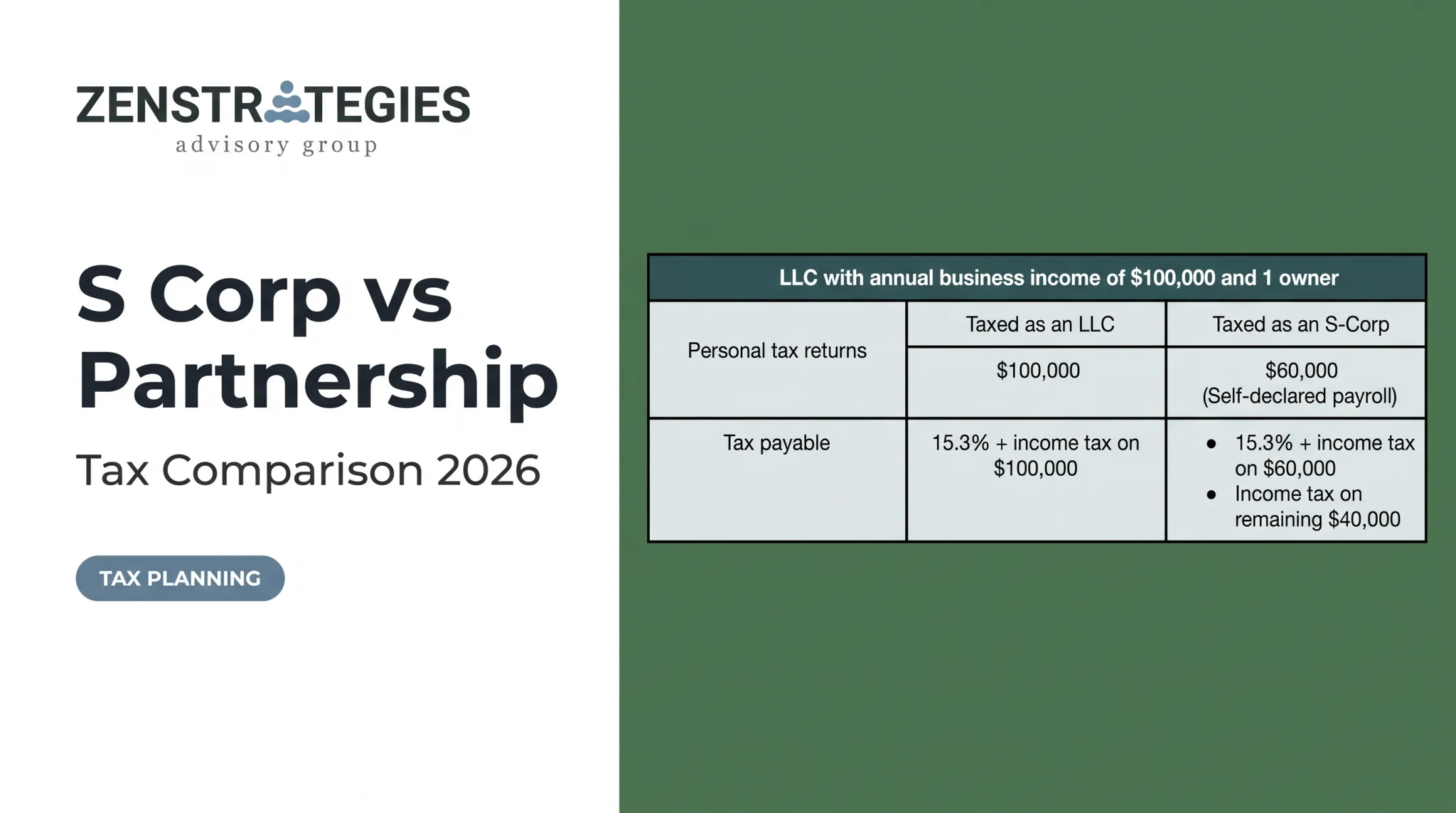

Shareholder-employees must pay themselves reasonable compensation for the work they actually do before taking a single dollar in non-wage distributions. The IRS has no magic number for this. There's no approved 50/50 or 60/40 formula — the defensible figure comes from your duties, your hours, your experience, what comparable roles pay, and your company's financial reality.
This guide walks through the standard, shows you how to calculate a supportable salary range, covers what's changing for payroll and tax reporting in 2026, and explains how to document the decision so it holds up if questioned.
Key Takeaways
- Reasonable salary reflects market pay for comparable work, not a fixed percentage of profit
- Base the number on duties, hours, experience, industry data, and company finances
- Distributions can't substitute for wages when an owner performs real services
- A dated compensation memo and time records strengthen your position if reviewed
- Confirm every 2026 federal and state payroll figure before applying it to your business
What Does "Reasonable Salary" Mean for an S Corp in 2026?
Treasury regulations define reasonable compensation as the amount ordinarily paid "for like services by like enterprises under like circumstances." That's the entire test. There's no dollar threshold, no percentage, no shortcut.
The IRS has said this directly: its own 2008 fact sheet states there are "no specific guidelines for reasonable compensation in the Code or the Regulations." Courts decide these cases on facts, not formulas.
That rule applies specifically to shareholder-employees: owners who perform meaningful services for the corporation, not passive investors.
Salary vs. Distributions vs. Pass-Through Income
These three terms get mixed up constantly, and the distinction matters:
- Salary is W-2 employee compensation, run through payroll, subject to Social Security and Medicare taxes
- Distributions are shareholder payments that typically skip payroll tax, but they don't escape income tax or basis rules
- Pass-through income is the S-Corp's profit reported on your K-1, taxable whether or not you actually withdraw cash
The IRS watches for one pattern above all others: an owner working full-time in the business while taking $0 or minimal wages and pulling the rest out as distributions. That's the red flag. There's no automatic minimum salary, but there's also no workaround for actively performing services and skipping payroll entirely.
Owners wearing multiple hats (running sales, doing the technical work, managing staff, handling admin) need to evaluate all of it combined. The title "owner" doesn't define the job; the actual work does.
One more distinction worth flagging: reasonable compensation is a federal tax issue. State wage law, unemployment insurance, and workers' compensation rules run on separate tracks and may apply regardless of how you set federal payroll.
How to Calculate a Defensible S-Corp Salary
Building a supportable number takes a process, not a guess. Here's the sequence that holds up.
- Inventory the actual duties. Write a job description covering every function you perform: sales, management, technical work, customer service, administration. Don't shortcut this to "owner."
- Estimate time and effort. Pull from calendars, time-tracking data, invoices, or project records. A part-time 15-hour-a-week role looks nothing like a 60-hour founder grind.
- Research comparable pay. The Bureau of Labor Statistics' Occupational Employment and Wage Statistics program publishes annual wage data by occupation, location, and percentile, a solid starting point alongside industry surveys and recruiting guides.
- Adjust for your specific facts. Factor in part-time hours, specialized experience, management scope, your local market, and company size. A solo operator running a $400,000 shop shouldn't be benchmarked against a regional VP salary.
- Set a range, then pick a number. Land on a supported range and choose a figure that fits the evidence, your cash flow, and the business outlook, then document why.
- Model the downstream effects. Check how the number affects payroll tax, QBI limitations, retirement contributions, and benefits. Tax savings shouldn't be the only variable in the equation.

Why 50/50 and 60/40 Don't Hold Up
These ratios circulate constantly in small business forums, but they're not IRS policy. A widely cited Journal of Accountancy analysis states plainly that the 60/40 split "is not an IRS rule" and that no regulatory or judicial authority supports it, calling the approach arbitrary.
If you want a starting point for internal discussion, fine, but treat it as a conversation opener, not documentation. The IRS doesn't accept a ratio defense in an exam. It wants comparable-pay evidence.
2026 Payroll, Tax, and Reporting Considerations
Once you've landed on a salary figure, the mechanics matter just as much as the number itself.
For 2026, the Social Security wage base rises to $184,500, with employees and employers each paying 6.2% up to that cap. Medicare tax (1.45% each side) applies to all wages with no ceiling, and an Additional Medicare Tax of 0.9% kicks in on employee wages above $200,000, with no employer match required.
| Item | 2026 Figure |
|---|---|
| Social Security wage base | $184,500 |
| Social Security rate | 6.2% employee + 6.2% employer |
| Medicare rate | 1.45% employee + 1.45% employer (no cap) |
| Additional Medicare Tax | 0.9%, employee only, over $200,000 in wages withheld |
| FUTA rate | 6.0% on first $7,000 per employee (often 0.6% net with full state credit) |

The operating sequence doesn't change: the corporation runs payroll, withholds the right taxes, pays its employer share, deposits on schedule, files quarterly returns, and issues a W-2. The S-Corp return separately reports pass-through items and distribution data through each shareholder's K-1. One doesn't substitute for the other.
A few things to verify before you finalize anything:
- Your payroll schedule (monthly, biweekly, or another cadence) complies with state requirements; plan year-end catch-up payroll rather than using it to dodge ongoing obligations
- Any other W-2 wages an owner earns elsewhere, which affects Social Security wage base tracking
- State unemployment, workers' compensation, and benefits obligations specific to your state
Confirm every figure above against current IRS guidance before filing. Thresholds shift, and last year's number is not this year's number.
How to Document, Pay, and Review the Salary
A defensible salary needs a paper trail. Build a compensation file that includes:
- The job description and time records supporting hours worked
- Comparable-wage research with sources, dates, and geography noted
- Prior-year compensation and how it compares to this year's figure
- Business financial statements showing what the company can support
Then write a short, dated compensation memo. It should explain which comparable occupations you used, what adjustments you made for experience or part-time hours, and why the final number fits the company's financial condition. Keep source documents on file rather than just a link: websites change, screenshots don't.
Get formal sign-off through your corporate records (shareholder consent works for most small S-Corps), then run it through payroll consistently. Reconcile your payroll reports, Form 941 filings, W-2 data, and distribution records at year-end to confirm everything lines up.
Review the number at least once a year, and sooner if duties, hours, staffing, or profitability change materially.
This is exactly the kind of work that gets skipped when accounting, payroll, and tax planning run as separate, disconnected tasks. At ZenStrategies, integrated monthly accounting and payroll review are built into the same engagement as tax planning, so the salary decision gets coordinated with accurate books rather than handled in isolation, without promising a specific audit outcome, since that's never guaranteed.
Common Mistakes and Consequences
Most reasonable-compensation problems trace back to a handful of recurring errors:
- Taking distributions with no wages at all while working full-time in the business
- Picking a salary from a fixed percentage instead of actual market data
- Using minimum wage with no factual basis for such a low figure
- Copying another owner's number without adjusting for different duties or markets
- Never tracking time, so there's no evidence behind the hours claimed
- Changing the salary year to year with no documented reason
When the IRS catches an unreasonably low wage, it can recharacterize distributions as wages, triggering back payroll taxes, amended filings, interest, and penalties. The landmark example here is Watson v. United States, where an Eighth Circuit ruling upheld a reclassification from $24,000 in reported wages to a court-determined $91,044 in reasonable compensation, based largely on compensation survey evidence.

Loss years and tight cash flow complicate this but don't erase it. Financial hardship can affect how much and when you pay, but it doesn't create an automatic zero-salary exception for an owner actively performing services.
And overcorrecting isn't safer, either. Paying an unnecessarily high salary drives up payroll cost and can distort QBI deductions, retirement contributions, and cash flow planning. The goal is a well-supported number, not the lowest or highest one you can justify.
Conclusion and Next Steps
Set your S-Corp salary based on the value of the work performed and the evidence behind it. Only then should distributions enter the picture.
Your action checklist:
- Inventory your duties and time commitment
- Pull comparable market wage data
- Adjust for your specific business facts
- Document the decision in a dated memo
- Get formal approval and run payroll correctly
- Reconcile records and review annually
Owners with multiple businesses, several shareholders, large distributions, or past payroll issues should get individualized advice before filing or amending anything. ZenStrategies works with established business owners across Ohio and beyond, pairing accounting, tax planning, and payroll review so compensation decisions rest on accurate numbers rather than guesswork.
Frequently Asked Questions
What should my S corp salary be?
It depends on your duties, hours, experience, comparable market wages, company size, financial condition, and what other employees earn. There's no universal figure or IRS-approved percentage to apply.
Does an S corp need to pay salary?
Yes. If you perform meaningful services for the corporation, you're treated as an employee and must receive reasonable wages before taking distributions. Startup or loss-year facts can affect timing and amount, but they rarely eliminate the requirement entirely.
What is the reasonableness standard?
It's pay for similar services by comparable businesses under similar circumstances. The IRS applies a facts-and-circumstances test rather than a fixed formula or ratio.
Do S-Corp distributions count as income?
Pass-through income is taxable whether or not it's distributed in cash. The distribution itself is typically tax-free up to your stock basis, but basis and other rules determine the exact treatment.
How do you determine a shareholder's basis in an S corporation?
Basis starts with your initial investment and is adjusted annually for income, deductions, losses, and distributions. Current Form 1120-S instructions and a tax professional can walk through the specific ordering rules.
How do S-Corp owners calculate their SEP contributions?
SEP contributions are based on eligible W-2 compensation, not distributions. The IRS treats distributions as non-earned income for retirement plan purposes. Verify current-year contribution limits and eligibility rules before calculating.